
© 2025 HKM Mumbai. All rights reserved.
© 2025 HKM Mumbai. All rights reserved.

Sri Narasimha Chaturdashi (Narasimha Jayanti) is the glorious appearance day of the half-man, half-lion incarnation of the Supreme Lord, as Sri Narasimha. The Lord appeared on the fourteenth lunar day (Caturdashi tithi) of the bright fortnight of the month of Vaishakha.
In Satya Yuga, there were two demon kings, namely Hiranyaksha and Hiranyakashipu. They were brothers, so when Lord Vishnu, as the boar Varaha, slew Hiranyaksha, Hiranyakashipu was very much aggrieved. In anger, he accused the Supreme Personality of Godhead of being partial to His devotees and derided the Lord’s appearance as Varaha to kill his brother. He began to agitate all the demons and disturb the ritualistic ceremonies of the peaceful sages and other inhabitants of the Earth.
After completing the last rites of his brother, Hiranyakashipu resolved to take revenge on Lord Vishnu and decided to conquer everyone and become the master of the entire universe. He did not want to be afflicted by bodily miseries like old age and illnesses, and did not want to be weak enough to be contested by any opponent. Thus, he went to Mandara Mountain and commenced the performance of severe austerities and penances, with the sole purpose of becoming immortal.
While Hiranyakashipu was thus engrossed in his meditation, fiery fumes began simmering from his head, distressing the entire universe and its inhabitants, the birds, beasts, and demigods. Being unable to tolerate the insufferable wafts of heat polluting the atmosphere of their planets, the demigods went to Lord Brahma and expressed their anguish. They told him about Hiranyakashipu’s intense desire to become immortal and the ruler of the creation, and implored Brahma to pacify the demon king.
As a result, Lord Brahma visited Hiranyakashipu. When the demon saw him, he began offering prayers and obeisances. Then, he requested Brahma to grant him the boon not to be killed by any living entity, not to be killed in any place, covered or uncovered, not to die in the daytime or at night, not to be killed by any weapon, on land or in the air, and not to be killed by any human being, animal, demigod or any other entity, living or nonliving. He further prayed for supremacy over the entire universe and requested the eight yogic perfections.
After Lord Brahma granted Hiranyakashipu these benedictions, he began to terrorise the universe and the demigods. He conquered the abodes of the demigods, including Lord Indra’s. He began enjoying a luxurious and gratifying life, always eating lavish food, drinking sweet wine, and being merry in his jewelled palace.
Soon, Hiranyakashipu’s wife, Kayadhu, gave birth to a charming little boy, Prahlad. Ironically, unlike his father, he was a great devotee of Lord Vishnu and always spent his time chanting His holy name. In school, he did not pay heed to the sinful instructions and philosophies of his demoniac teachers, and instead preached to his classmates the essence of bhakti yoga. Despite being chastised and reprimanded by his teachers and Hiranyakashipu himself, Prahlad refused to submit to his father’s claim as the immortal lord of the universe.
Therefore, at the direction of Hiranyakashipu, the demons and the servants began employing different methods to kill Prahlad. They began striking his tender body with their tridents, shouting, “Chop him up! Pierce him!” Nevertheless, since Prahlad was silently meditating on the Lord, their efforts proved to be pointless.
Hiranyakashipu then threw him under the feet of elephants and among vicious snakes, and he conjured up destructive spells and illusory tricks. He hurled Prahlad from the top of a hill, poisoned him, starved him, stoned him, and made him shiver in the wind, burn in fire, freeze in the cold, and drown in water.
Consequently, the murderous ventures of Hiranyakashipu had no tangible effects upon Prahlad Maharaj because he was a devotee undisturbed by material conditions and fully engaged in meditating upon and serving the Supreme Lord, who is unchangeable, who cannot be realised by the material senses, and who is the soul of the entire universe.
Thus riled by Prahlad’s staunch faith in the Lord, Hiranyakashipu became overwhelmed with fury and rebuked his son as follows,
O most unfortunate Prahlāda, you have always described a supreme being other than me, a supreme being who is above everything, who is the controller of everyone, and who is all-pervading. But where is He? If He is everywhere, then why is He not present before me in this pillar? Because you are speaking so much nonsense, I shall now sever your head from your body. Now let me see your most worshipable God come to protect you. I want to see it. (SB 7.8.12-13)
In a ghastly fit of rage, Hiranyakashipu struck the pillar with his fist. Suddenly, a tumultuous sound was heard, which reverberated throughout the entire universe. This sound sent quivers of fear rippling down the spines of the demigods, and erupted anxiety through the hearts of the other demon kings.
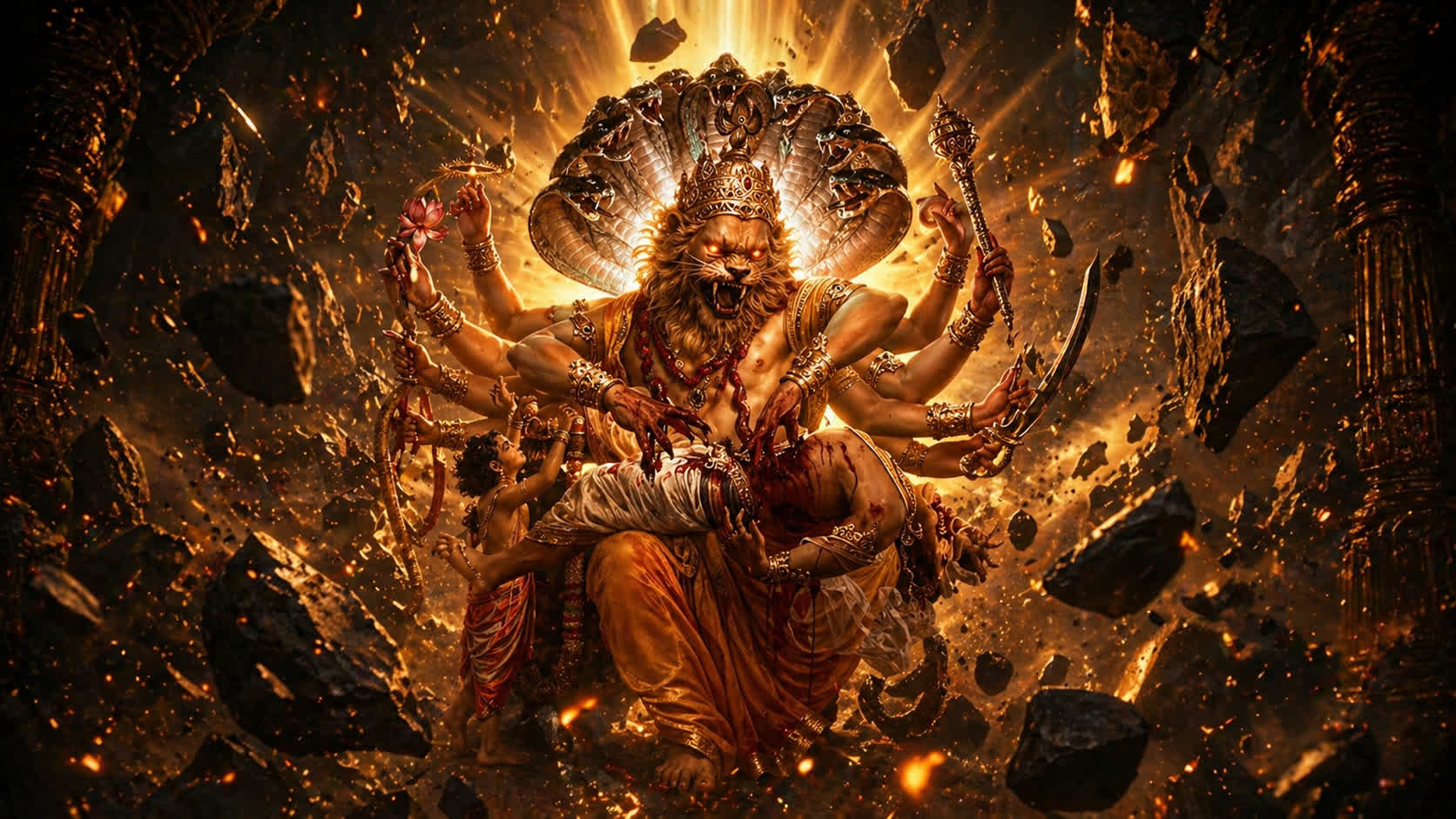
From the pillar emerged the Supreme Personality of Godhead, Hari, who had assumed the roaring form of half-man, half-lion. His eyes shone with anger, looking like molten gold; his great mane ruffled in the breeze, his mighty body touched the sky, and his strong arms flailed through the air, as He killed the demons, rogues, and atheists with His disc, conchshell, lotus, club, and other weapons.
Hiranyakashipu, initially struck with awe and wonder, re-entered his livid state and began attacking the Lord. Thus, a furious battle ensued between the two, with rivers of blood seeping through the chamber. Eventually, just as a snake captures a mouse, or Garuda ensnares a venomous snake, Lord Narasimha captured Hiranyakashipu and placed him on his lap. He sat in the doorway of the royal assembly and ripped apart the demon’s body with his razor-sharp fingernails.
On seeing the painful and bloody demise of Hiranyakashipu, all of the inhabitants of the universe exploded with joy and relief. The demigods, headed by Lord Brahma and Lord Shiva, congregated in the assembly. Prahlad Maharaj, ecstatic to see the Lord, went to Him and offered a series of wonderful prayers.
Thus, to prove that the statement of His servant Prahlāda Mahārāja was substantial—in other words, to prove that the Supreme Lord is present everywhere, even within the pillar of an assembly hall, He appeared as Lord Narasimha.
Of the nine islands of Navadvipa, which is located near West Bengal, one is known as Godrumadvipa. After killing Hiranyakashipu, Lord Narasimha arrived on this island, particularly to a place now known as “Narasimha Palli”.
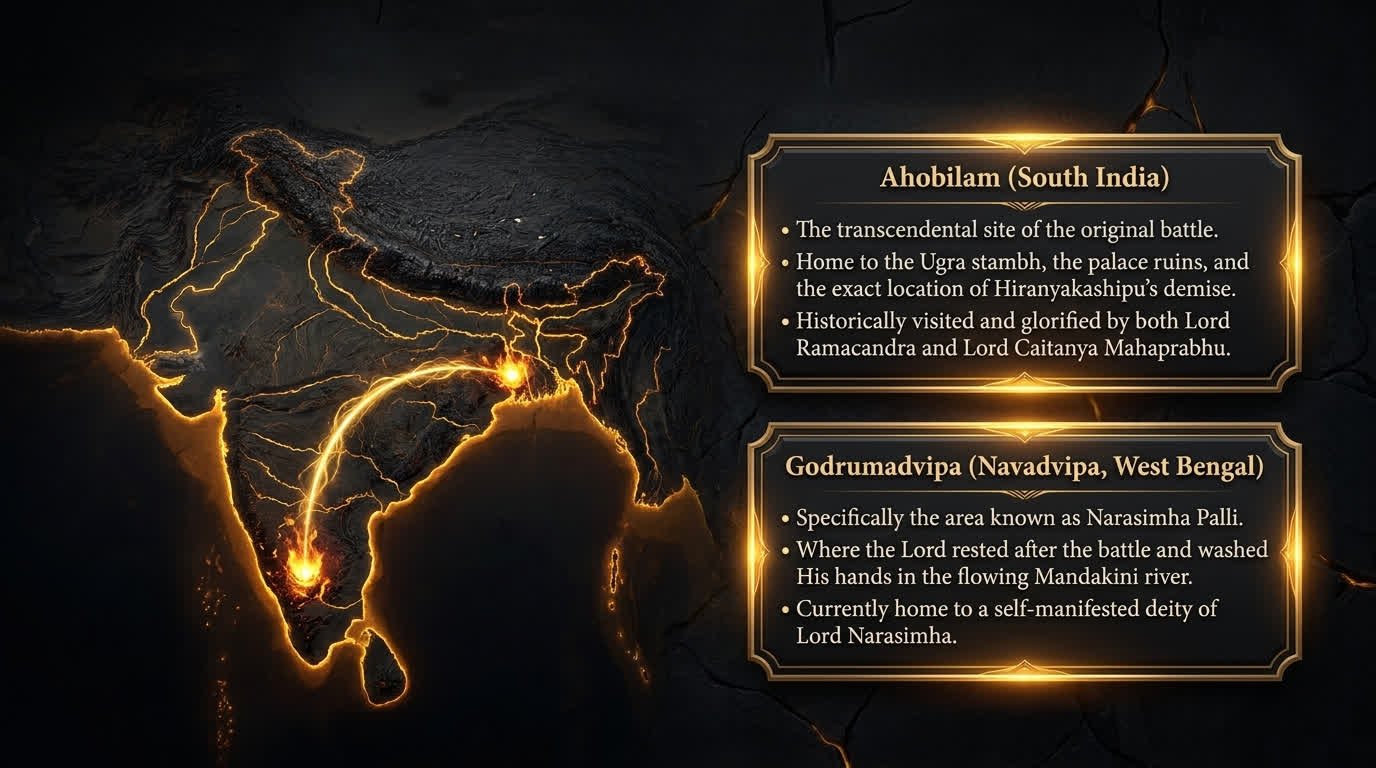
Here, the Lord rested for some time and washed His hands in the river Mandakini, which used to flow. The demigods worshipped Him for a while, until He decided to disappear from the place.
However, a deity of Lord Narasimha later manifested itself and is now worshipped in a temple at Narasimha Palli.
Ahobilam is the transcendental place where Lord Narasimha appeared to protect His dear devotee Prahlad from the murderous nature of his father, Hiranyakashipu. Here, the Lord emerged from a mighty pillar, known as “Ugra stambh”, and battled with the demon, eventually slaughtering him.
The pillar from which Lord Naraimhadeva came, the remains of Hiranyakasipu's palace, the precise location where Lord Narasimhadeva slew Hiranyakasipu, and the school where Prahlada learned are still present in Ahobilam. Lord Caitanya Mahaprabhu visited Ahobilam on His journey to South India, as described in Sri Caitanya Caritamrta. Lord Ramacandra also came here and recited some glorificatory verses.
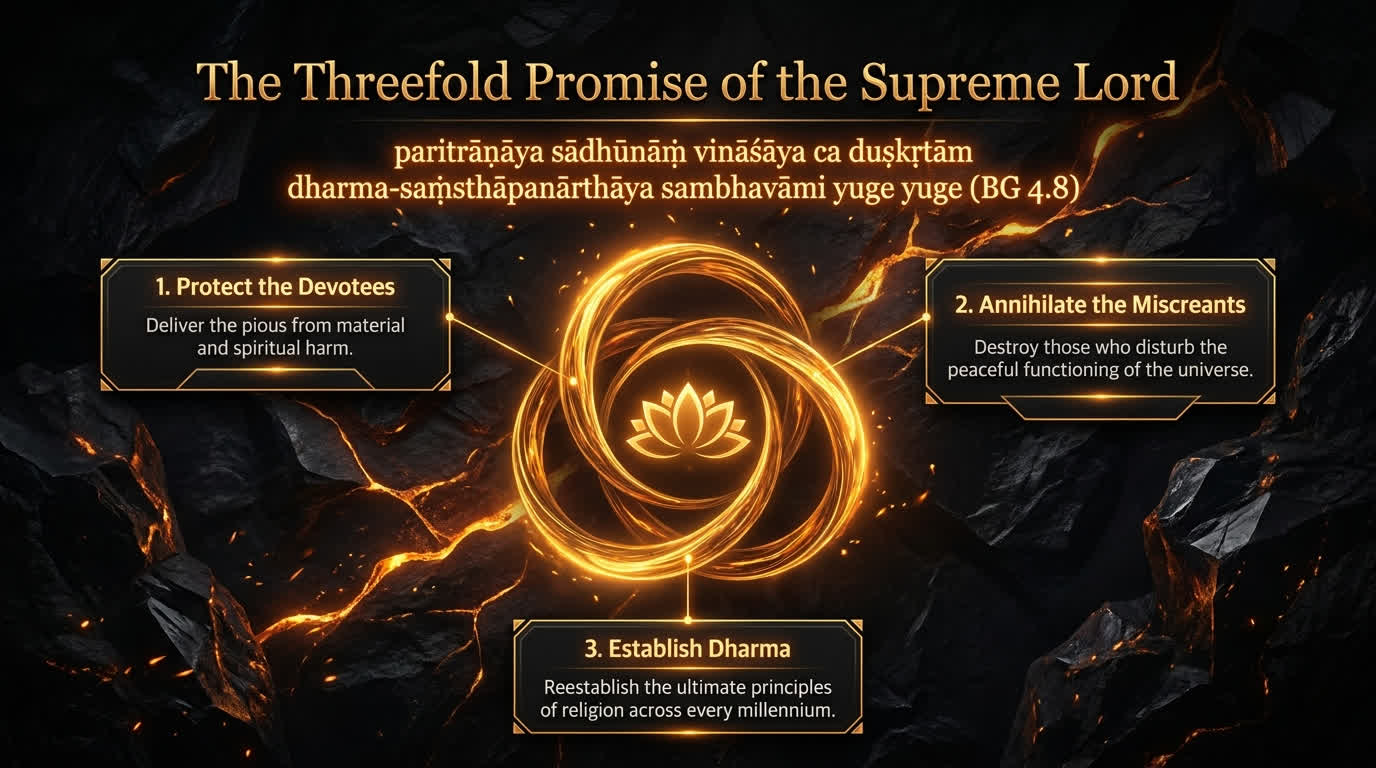
In the Bhagavad-gita, Lord Krishna gives three reasons for His advent in this material world: to annihilate the demons, to protect the devotees, and to establish dharma (BG 4.8).
paritrāṇāya sādhūnāṁ
vināśāya ca duṣkṛtām
dharma-saṁsthāpanārthāya
sambhavāmi yuge yuge
In order to deliver the pious and to annihilate the miscreants, as well as to reestablish the principles of religion, I advent Myself millennium after millennium.
By hearing the pastime of Lord Narasimha’s appearance, we can thus construe that He, in fact, did advent to destroy the demon Hiranyakashipu and save His devotee Prahlad. However, which “principles of religion” were established?
Prahlad Maharaj preached to his father and his friends about the significance of Krishna consciousness and expounded its philosophy in great detail. His teachings can be boiled down to their very essence by understanding the following verse he had recited (SB 7.5.23):
śravaṇaṁ kīrtanaṁ viṣṇoḥ
smaraṇaṁ pāda-sevanam
arcanaṁ vandanaṁ dāsyaṁ
sakhyam ātma-nivedanam
Prahlāda Mahārāja said: Hearing and chanting about the transcendental holy name, form, qualities, paraphernalia and pastimes of Lord Viṣṇu, remembering them, serving the lotus feet of the Lord, offering the Lord respectful worship with sixteen types of paraphernalia, offering prayers to the Lord, becoming His servant, considering the Lord one’s best friend, and surrendering everything unto Him (in other words, serving Him with the body, mind and words) — these nine processes are accepted as pure devotional service.
He further mentioned that the one who can spend his life engaged in the service of the Lord via these nine methods will fulfil the topmost goal of human life - going back home, back to Godhead.
Yet, of all of the abovementioned processes, the hearing and chanting of the Hare Krishna mahamantra, i.e. shravanam and kirtanam, are considered to be the greatest and the most potent methods to attain the love of Krishna.
Especially in this age of Kali, where demoniac qualities like hypocrisy and quarrel are rampant amongst everyone, the Holy name of the Lord is said to be the best and the only way to protect ourselves from these vices (kalau nāsty eva nāsty eva nāsty eva gatir anyathā).
This recommendation by Sri Chaitanya Mahaprabhu, who established this sankirtana movement in Kali Yuga, should therefore be adopted by everyone and also preached. After all, the sum and substance of this transcendental movement is to chant and hear the Hare Krishna maha mantra, and give others the opportunity to do the same.
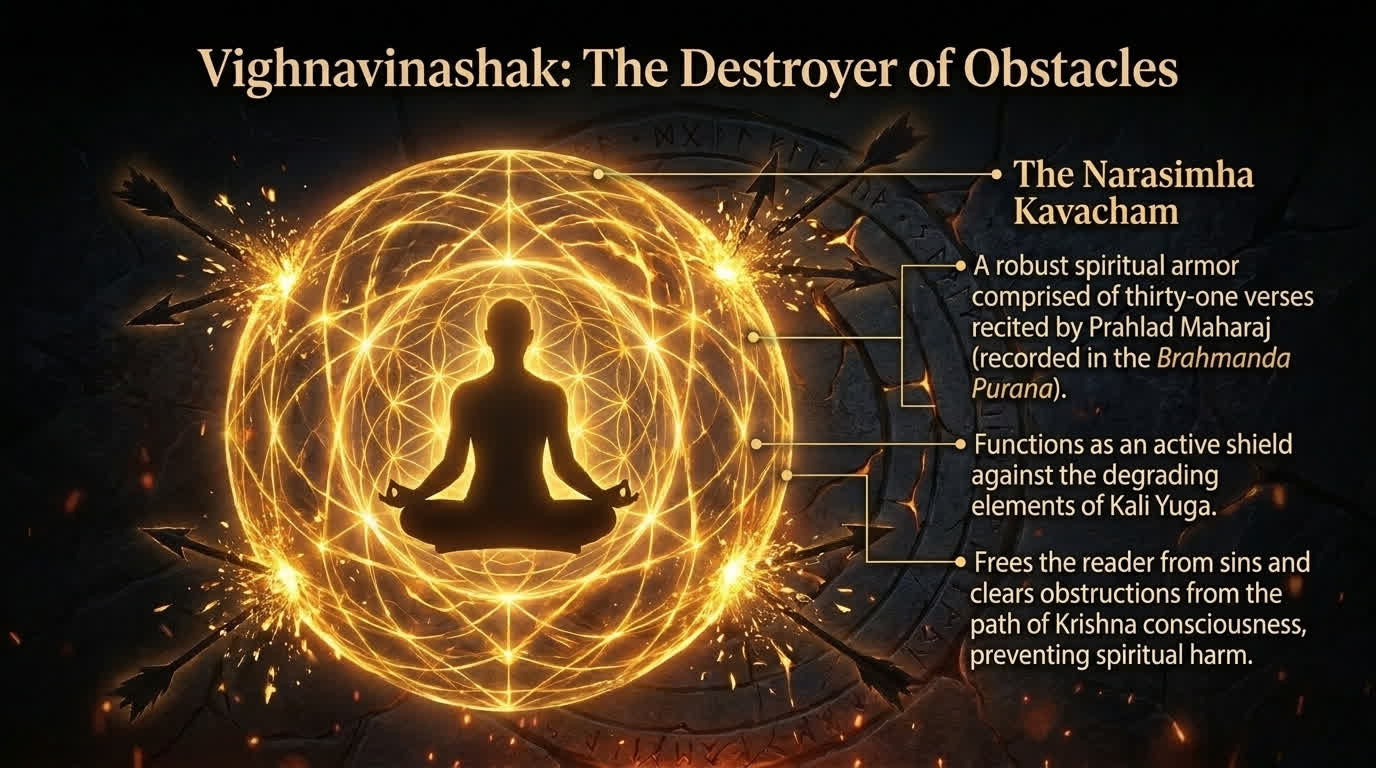
Another way to protect ourselves from the elements of Kali is by the recitation of the Narasimha Kavacham. This set of thirty-one verses, recited by Prahlad Maharaj and written in the Brahmanda Purana, praises Lord Narasimha and requests Him to bless one with protection.
Lord Narasimha particularly protects us from spiritual suicide, which is why He is fondly known as “Vighnavinashak”, or the destroyer of obstructions in the path of Krishna consciousness. Indeed, these prayers shield us from spiritual harm like a robust armour (kavacha) such that a devotee who reads this becomes freed from all sins (Narasimha Kavacham verse 20).
In the Caitanya caritamrita, Srila Krishna das Kaviraj Goswami describes a magnificent pastime of Sri Caitanya Mahaprabhu. One day, He ordered Srivas Thakur to recite the Brihat-sahasra-nama, i.e., the one thousand names of Lord Krishna, to Him.
As Srivas Acharya read the different names, the holy name of Lord Narasimha appeared. On hearing this, Mahaprabhu became absorbed in thought and assumed the fiery mood of Lord Narasimha.
Hence, He began racing through the streets, club in hand, determined to kill all of the atheists. Seeing this fierce and ecstatic disposition of Sriman Mahaprabhu, everyone started running from Him in fright.
On seeing the panic-stricken state of the people, the Lord came to His external senses and threw the club.
When He returned to Srivas Thakur’s home, Mahaprabhu became doleful and expressed His inner condition to him. He stated that, upon observing the people's fearful state, He had regained His composure to avoid committing any offences.
Srivas Acharya, on the other hand, reassured Lord Caitanya. He said that since by the chanting of His holy name even the ten million offences of a person would be vanquished, He had not caused any harm by appearing as Narasimhadeva.
On the contrary, he added that anyone who had laid eyes on this ecstatic and esoteric form of Lord Gauranga would be instantly liberated. (CC Adi lila, 17.90-98)
Navadvipa is the birthplace of harinama sankirtan, which Sri Caitanya Mahaprabhu established. And so, He ordered all of Navadvipa’s citizens to chant the Hare Krishna maha mantra. As a result, soon, every home began reverberating with the sound of the Holy name.
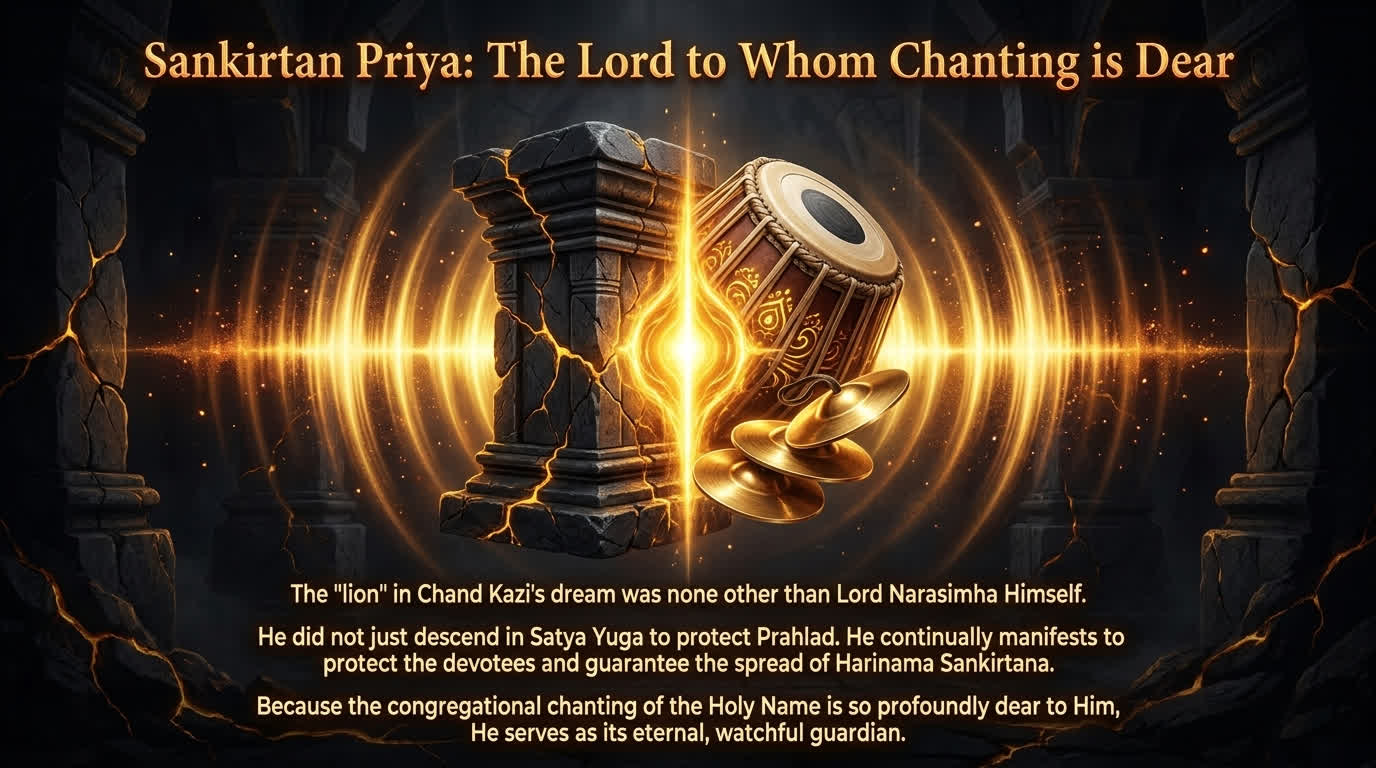
Hare Krishna sankirtan spread throughout Navadvipa like wildfire, and kartals and mridangas clashed and boomed in a deafening din.
This greatly disturbed the local Muslims, who complained to the magistrate Chand Kazi. One evening, he stopped by a house and, on hearing the sounds of kirtan resounding there, broke a mridanga and lashed out at the devotees.
He immediately commanded them to cease chanting and brutally admonished that the performance of sankirtana on the streets should be stopped. Chand Kazi further threatened that if any devotee was heard chanting, his property would not only be confiscated, but he would also be forcefully converted to a Muslim.
When Caitanya Mahaprabhu heard about this incident, He became angry and ordered the devotees to perform Hare Krishna kirtan in the streets. When He saw that they were still anxious, He reassured them by promising to join them in the evening and protect them from Chand Kazi’s wrath.
In the evening, as they sang and danced in the streets, the devotees came to the doorstep of Kazi, who, frightened by the large throngs of Vaishnavas, hid in his room. The devotees, however, continued to chant and also wrecked his house and flower garden in agitation. This was the first civil disobedience movement of all time.
Gauranga Mahaprabhu sat at the doorway of Kazi’s house and sent for someone to call him. When the Kazi came, He greeted him with much respect and honour. As the duo began debating the authenticity of the Vedas, Puranas, and the Koran, Chand Kazi admitted defeat. He then revealed to the Lord a confidential secret.
He expressed that when he had broken the devotee’s mridanga, he had seen a special dream that night. In that, a greatly powerful lion, with a human-like body and lion-like face, pounced on his chest and roared with anger. The lion then laughed and gnashed His teeth and scolded Chand Kazi, saying,
“I shall immediately bifurcate your chest as you broke the mridanga drum! You have forbidden the performance of My congregational chanting. Therefore, I must destroy you!” (CC Adi lila, 17.181-182)
Chand Kazi shook and trembled with fear, to which the lion said,
“I have defeated you just to teach you a lesson, but I must be merciful to you. On that day, you did not create a very great disturbance. Therefore, I have excused you and not taken your life. But if you perform such activities again, I shall not be tolerant. At that time, I shall kill you, your entire family and all the meat-eaters.” (CC Adi lila, 17.183-185)
Chand Kazi then showed Caitanya Mahaprabhu his chest, which was scarred with the marks of the lion’s nails. This “lion” was none other than Lord Narasimha, who had once again come to protect the devotees and to encourage harinama sankirtan. This is why He is fondly known as “Sankirtan priya”, or the Lord to Whom harinama sankirtan is very dear.
If you wish to delve deeper into the teachings of Prahlad Maharaja, you can read Srila Prabhupada’s books on the same, especially the Transcendental Teachings of Prahlad Maharaja. Hard copies are also available through the Hare Krishna Movement Mumbai's online store.

